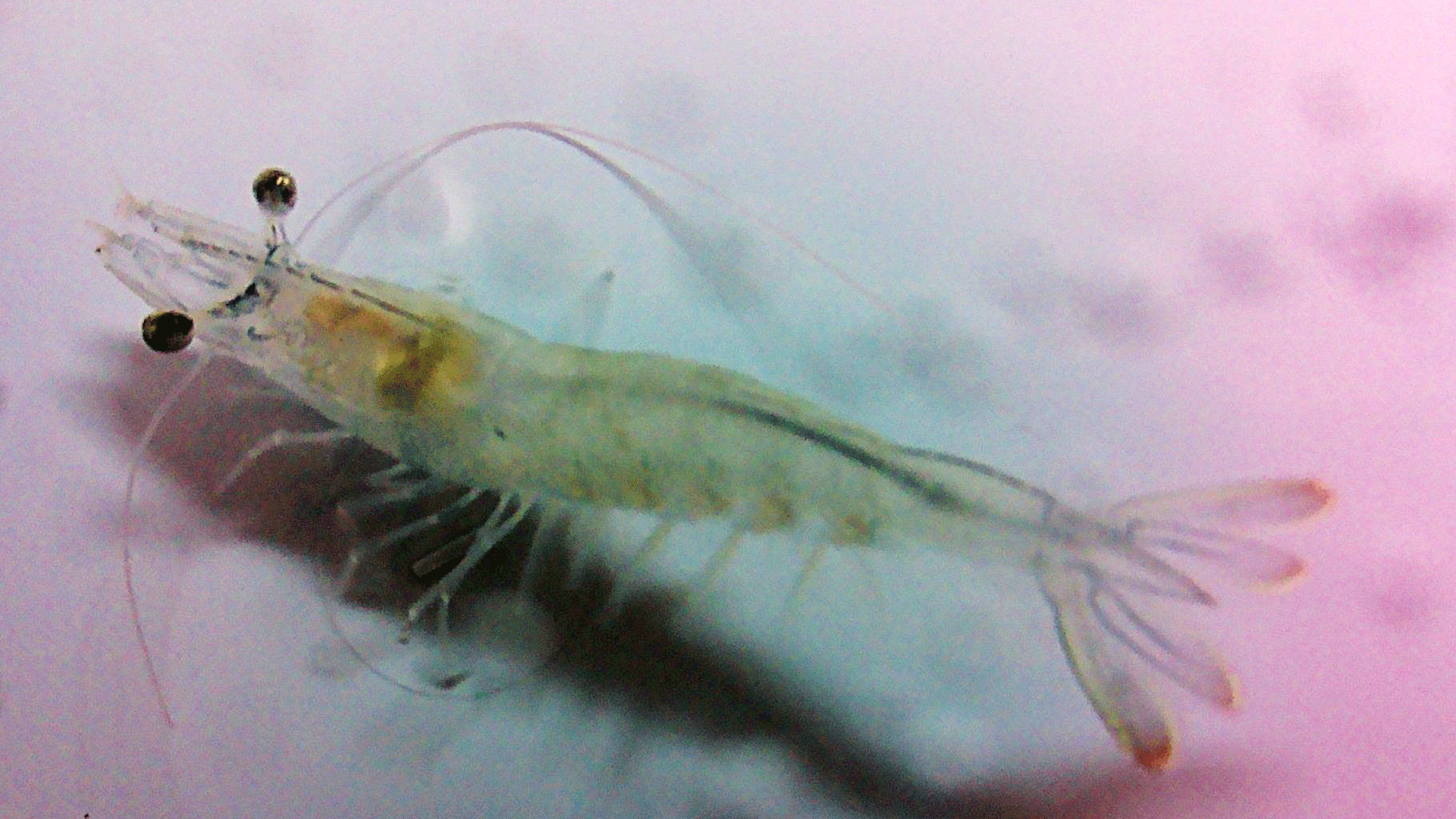
A collaborative project between DTU Aqua and the Danish start‑up company Sincere Aqua ApS is underway to create an entirely new tool to support European shrimp production.
In the project Sincere Shrimp Disease Detector (SSDD), researchers and the company are developing a system that uses artificial intelligence to detect early signs of disease in warm‑water shrimp long before they become visible to the human eye.
Although Europe’s shrimp production is still small, the technology could have significant impact on aquaculture production. Several companies are expected to explore intensive indoor farming, and in this context, disease management will become one of the biggest barriers.
“By the time a farmer can see that a shrimp looks sick, the disease may already be spreading. We’re working on a tool that can warn much earlier – possibly before anyone notices something is wrong,” says co-leader af the project Shyam Kokkattunivarthil Uthaman from DTU Aqua, Section for Fish and Shellfish Diseases.
White spot disease as case test – and cameras running non‑stop
To train the AI model, researchers carried out controlled infection trials with white spot disease, one of the most devastating shrimp diseases worldwide. Underwater cameras recorded the shrimp continuously, allowing the system to learn patterns in behaviour and appearance that indicate illness.
Early findings are promising:
“The cameras capture very subtle behavioural changes – things humans would never notice, especially in large tanks with thousands of animals,” explains Shyam.
A proof of concept for Danish research in fish and shellfish diseases – from fish to shrimp
Denmark has only just established its first warm water shrimp facility, and the kind of technology used in the shrimp disease detector is already in place across the aquaculture sector in Denmark.
Previous research has shown that computer vision systems can detect early signs of disease in rainbow trout, including Red Mark Syndrome.
"Our project is a proof-of concept in shrimp farming. Similar technologies for fish are already in place, and our technology will be an added attempt to improve those research.” Shyam says.
A European sector ready for new solutions
Nearly 300 members participate in the EUROSHRIMP network, indicating a fast‑growing interest in modern, technology‑driven aquaculture.
Many new European farms struggle with high labour costs and a shortage of high‑quality juvenile shrimp – challenges that make automated monitoring especially attractive.
“If we can automate the earliest part of disease detection, farmers could save labour and avoid large losses. That’s a big step forward,” says Shyam.
Next steps: From the lab to real‑world farms
The next phase will focus on fine‑tuning the system and testing it in commercial settings. Researchers believe the tool could become an early‑warning system that constantly monitors animals in the background.
“The idea is a continuous online monitoring tool – an extra pair of eyes in the tanks,” says Shyam.