Facilities for research within fisheries technology, Hirtshals
DTU Aqua operates unique, purpose-built facilities for fisheries technology research and development in Hirtshals, Northern Jutland.

In Hirtshals in Northern Jutland, DTU Aqua operates advanced, purpose-built facilities for fisheries technology research and development. These state-of-the-art facilities provide the foundation for the institute’s leading research and education in sustainable fisheries technology. The facilities are unique in Denmark and recognized internationally for their quality and capabilities, making them a leading hub for cross-institutional collaboration.
At these facilities, DTU Aqua addresses a broad spectrum of research challenges within sustainable fisheries technology. Current focus areas include technological innovation and advancing our understanding of the physical impacts of fishing operations, as well as how aquatic animals respond to different fishing gears and external stimuli. From small-scale pilot studies to semi-commercial and full-scale validation, the facilities provide flexible, tailored environments for testing, technology maturation, and innovation.
This infrastructure enables rapid iteration, reduces technical and operational risk, and supports evidence-based decision-making on land before well-characterised solutions are tested at sea, where trials are inherently costly and logistically demanding.
Learn more below about the facilities.
Facilities for quantifying the physical impact of fishing
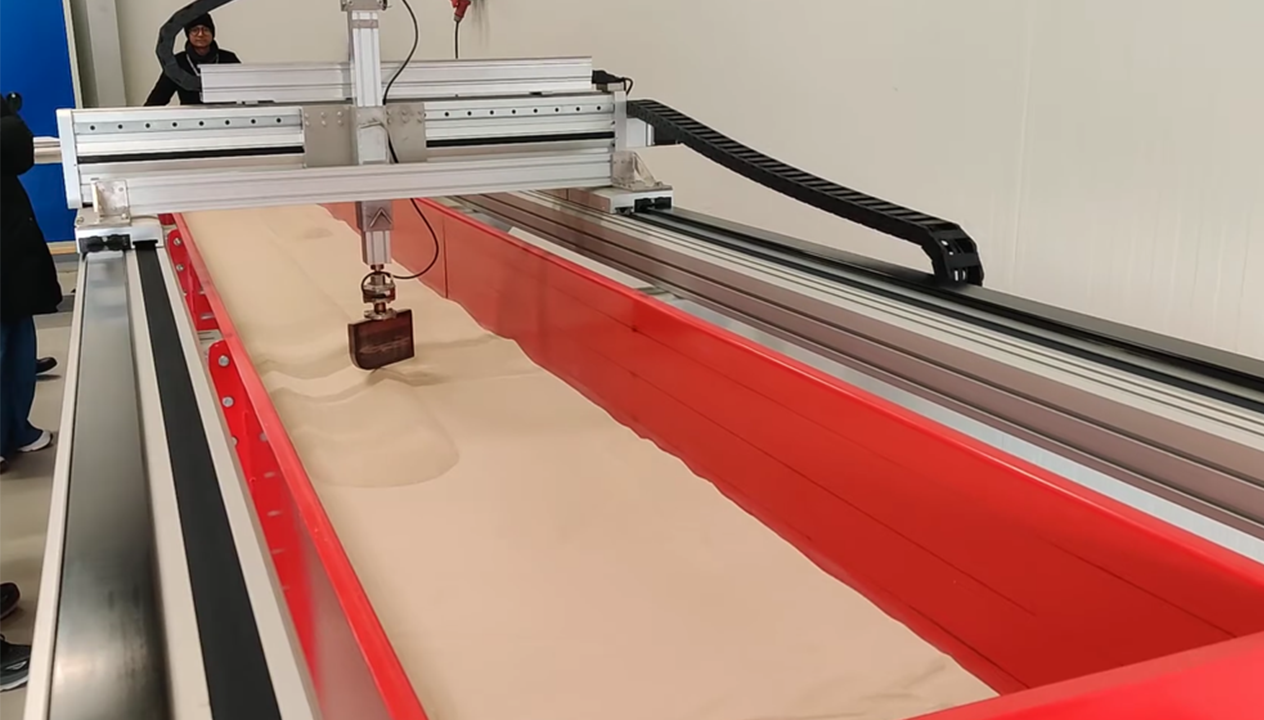
Our cutting-edge 6-metre sand channel enables advanced research into the physical impacts of fishing on the seabed. Equipped with a precision gantry system, the facility can tow model fishing gear across a variety of sediment types, delivering detailed insights into gear–seabed interactions.
Designed for flexibility, the channel operates in both dry and water-filled conditions, allowing researchers to replicate real-world environments and explore the forces acting on the modelled fishing gear components and how sediments respond under different scenarios. This unique capability supports high-impact research that drives innovation towards more sustainable fishing practices.
Facilities for AI-applications in fisheries
To support and accelerate the development of electronic monitoring (EM), our lab is equipped with catch sorting facilities to resemble the most common commercial set-ups. This includes a sorting band, sorting table, de-watering system and pounder that can be used to develop AI-powered computer vision models applicable across a wide range of vessel types and fisheries.
This is complemented by the testing and refinement of innovative hardware solutions designed to enhance monitoring accuracy, efficiency, and scalability.


Facilities for the testing and advancement of new materials
We are advancing the next generation of materials for fishing gear. With increasing focus on reducing reliance on petroleum-based plastics, our research explores and evaluates bio-based alternatives for use in fisheries applications.
Our facilities provide the full suite of capabilities needed to design, test, and analyse these materials, including tensile testing machines, hyperspectral imaging, and in-house development of gear components using 3D printing technologies.


Facilities for understanding animal behaviour in relation to fishing gears
Understanding how animals behave in and around fishing gear is essential for improving the capture processes of different fishing gear and develop sustainable fisheries. Our facilities enable a wide range of experimental studies, including testing of swimming kinematics and sensory capacities, bait experiments, and investigations of different stimuli and deterrents.
These studies are conducted in our 3-metre-long swim tunnel, which allows to test flow velocities up to 2 m/s, and in our live fish laboratory, which comprises six 1.5-metre diameter tanks and two 2-metre diameter tanks. Together, these facilities provide controlled, high-quality environments for advancing knowledge of animal behaviour and gear interactions.

