PhD at DTU Aqua
The PhD programme at DTU Aqua educates future researchers within the institute's research areas for a career in academia or business.
PhD students and projects at DTU Aqua within the research area Marine Biodiversity and Human Pressures.
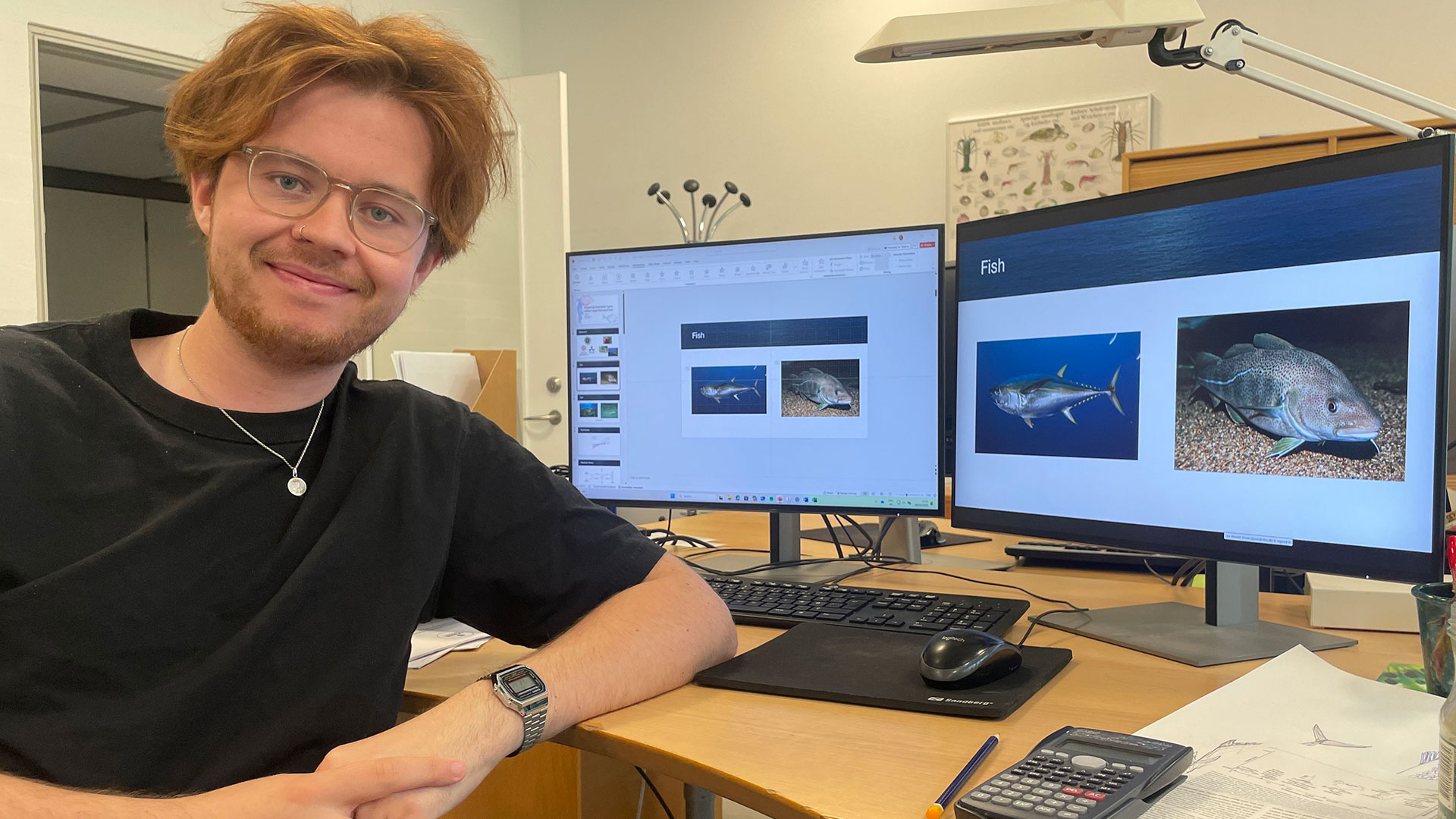
Title of the PhD project
Challenging the fish growth paradigm in a changing climate
Background of the project
How growth varies between organisms is of special interest in the context of climate change as we hope to anticipate changes to ecosystem structure and function, following previously established associations of biological rates and environmental variables. Typically, one would expect an organism to grow at a faster rate in warmer waters. This has been shown to occur both intra- and interspecifically. Recent work has shown that this is not in fact the case for large demersal fish, predators that live on the sea floor on continental shelves. If this group of organisms doesn’t play by the same rules as others, what impacts could that have on global marine ecosystems?
About the project
The aim of this project is to create a framework where the dynamics of growth in large demersal fish can be more accurately represented in global ecosystem models. To do this I will use morphological data to identify differences in demersal species across a range of temperatures to demonstrate niche differences. Using these relationships, I will work with an existing trait-based food-web model and incorporate the different strategies of large demersal fish which will elucidate more realistic ecosystem dynamics.
Perspectives
This project will provide insights into how large demersal fish, a functional group with great commercial interest, grow across latitudes and potentially respond to warming. Improving our understanding of this process is vital to effective management of coastal shelf marine ecosystems.
Supervisors
P. Daniël van Denderen and Martin Lindegren, DTU Aqua

Title of the PhD project
Modelling the pace of life of marine fish
Background of the project
Fish are constantly interacting with other fish and with their environment; that shapes how different fish feed, grow, reproduce, and survive – and even how they look like. Fish community models translate these interactions to mathematical equations to estimate trophic links, community structure and biomass.
Trait-based approaches model individuals instead of species by identifying a few dominant traits and trade-offs that characterize the “average” fish. Body size is the primary trait in most models because several traits scale with it (e.g. metabolism, maximum consumption) and because it serves as a proxy for trophic level in marine systems – where the general rule of “big eats small” applies. However, body size is not enough to explain the diversity of marine fish…
About the project
This project will investigate what explains marine fish diversity beyond body size. Our candidate is pace of life: a qualitative measure of the rate at which an individual progresses through life. It has been correlated with both physiological and life-history traits and can be described by trade-offs between growth, reproduction and survival.
My hypothesis is that adding pace of life as a secondary trait can improve the mathematical representation of marine fish in the size- and trait-based fish community model, FEISTY.
Perspectives
Fish community models directly depend on the quality of current knowledge on fish physiology and ecology. If my hypothesis is confirmed, it will improve the forecast of fish community biomass and re-assembly on a global scale, and contribute to the study of past, present and future scenarios under climate change and fishing pressure, among other applications.
Supervisors
Daniël van Denderen and Ken Haste Andersen, DTU Aqua
Presentation of the PhD project will follow.
The PhD programme at DTU Aqua educates future researchers within the institute's research areas for a career in academia or business.
Katrina Bromhall
The effect of modified and lightweight fishing gears on benthic macrofauna
Elliot John Brown
Habitat Suitability for Juvenile Flatfish of the Inner Danish Waters
Louise Dahl Kristensen
The importance of habitat structure for the distribution and behaviour of demersal fish
Teunis Jansen
North Sea Mackerel or Mackerel in the North (Sea)?